There is a peculiar grammar to luxury dining in a city that does it better than almost anywhere else on earth. Bangkok does not want for ambition at altitude. It has been stacking restaurants on top of hotels for long enough that the 52nd floor has begun to feel less like a privilege and more like a category — a genre with its own predictable furniture, its own reliable views, and its own reliable disappointments. You know the room before you enter it. The question, always, is whether the kitchen has managed to forget that it is performing at height.
Saffron has been performing at the top of the Banyan Tree Bangkok since the hotel opened in 1996, long enough to have earned a certain confidence, and long enough, it turns out, to have calcified into something that feels less like a living restaurant and more like a very expensive memory of one. A colleague and I were seated promptly and warmly at a window table. The welcome was genuinely good: efficient, smiling, unhurried. The room, however, was another matter entirely. The décor reads as someone's best guess at Thai opulence circa 2002 — darkened timbers, heavy fabrics, gilt-edged Thai motifs that were bold when the Banyan Tree brand was finding its identity and now simply look tired. The view from our window had the architectural misfortune of facing a particularly indifferent angle of the skyline. Bangkok stretches below in every direction, and yet our sightline had managed to find the least interesting part of it.
The amuse-bouche arrived at precisely the wrong moment: two varieties of rice cracker with four accompanying relishes, deposited on the table simultaneously alongside the drink and the starter, as if the kitchen had lost faith in sequencing entirely. Two of the four relishes had real merit. One was deep and umami, the kind of rounded savouriness that makes you reach immediately for another cracker. The second was bright and refreshing, coconut-forward in a way that cleansed rather than coated. The other two contributed nothing memorable. The problem was structural: with too few crackers and the wrong company at the table, the moment collapsed before it had properly formed. These things should have arrived with the drink, alone and given space. Instead they competed.
That drink, for the record, was well made: a mango mocktail, properly balanced, correctly chilled, one of the only things that evening to arrive both on time and in good order.
The starter, the Goong Sarong Buer Tod, was the undisputed high point of the meal and by some distance. A prawn wrapped in crisp rice noodle, served on a fried betel leaf with sweet mango chili sauce, it was composed and considered in a way that briefly gave the impression everything which followed might rise to meet it. The prawn had sweetness and genuine texture; the noodle casing shattered cleanly without aggression; the betel leaf contributed a faintly anise-edged bitterness that cut against the sauce with real intelligence. It was the one dish of the evening that knew precisely what it was doing.
The spare ribs arrived on the bone, which is the correct and courageous way to serve them — the flesh pulling away cleanly, the anticipation of something serious building with each bite. The anticipation was not rewarded. The meat was adequately tender and nothing more, seasoned with little beyond salt, carrying none of the caramelised depth or secondary complexity that a rib preparation at this price point is obliged to deliver. It is a dish that promises and then simply stops.
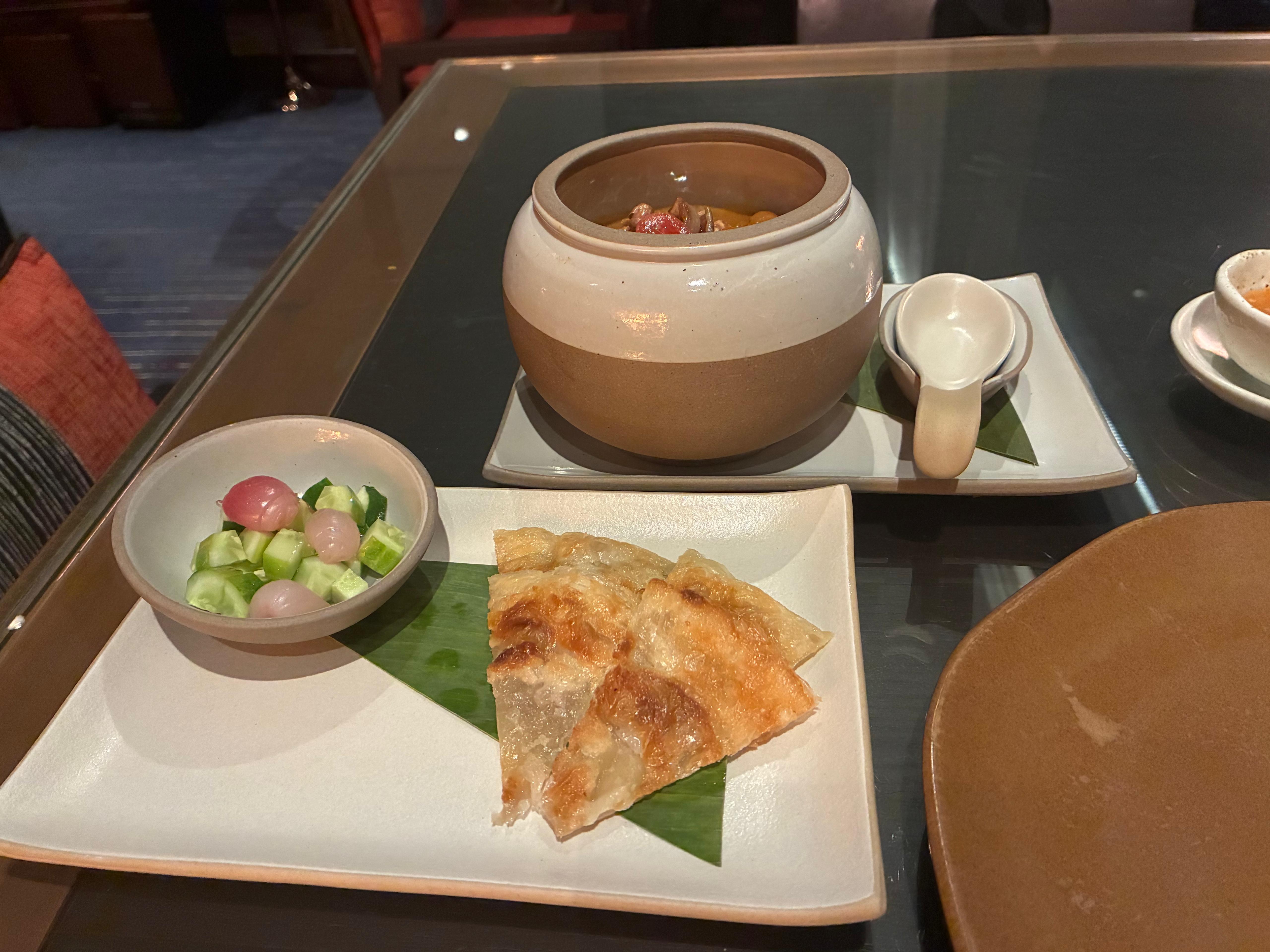
The vegetarian massaman curry was a more instructive failure. Massaman depends on the management of richness — coconut milk, roasted spice, the slow accumulation of fat and sweetness — and the correct kitchen response is contrast: something sour, something bright, the traditional pineapple that exists not as garnish but as structural necessity. It was absent. What arrived was a bowl of considerable salt. The broccoli had been added at the same stage as everything else, its texture a casualty of an undifferentiated approach to timing. The roti that accompanied it had been reheated, butter applied as a cosmetic measure to mask a dough that had gone stiff some time before it reached the table. The cucumber relish — two types of cucumber and pickled shallots — was not worth the real estate it occupied on the table.
Service through the meal was pleasant in the way that pleasant often becomes invisible: it functioned, it did not offend, it brought things when asked.
Saffron has the bones of something that should work. The welcome has warmth. The starter demonstrated that the kitchen knows what precision looks like. But a restaurant at this altitude — and at these prices, where a considered two-person meal with drinks lands somewhere north of THB 5,000 before service and tax, and considerably more if you venture into the upper reaches of the menu — cannot survive on one dish per visit. Bangkok has too much competition at every level for a restaurant to coast on its history and its floor number. The view from the 52nd floor is only interesting for as long as the plate in front of you fails to hold your attention. At Saffron, that is rather too often.