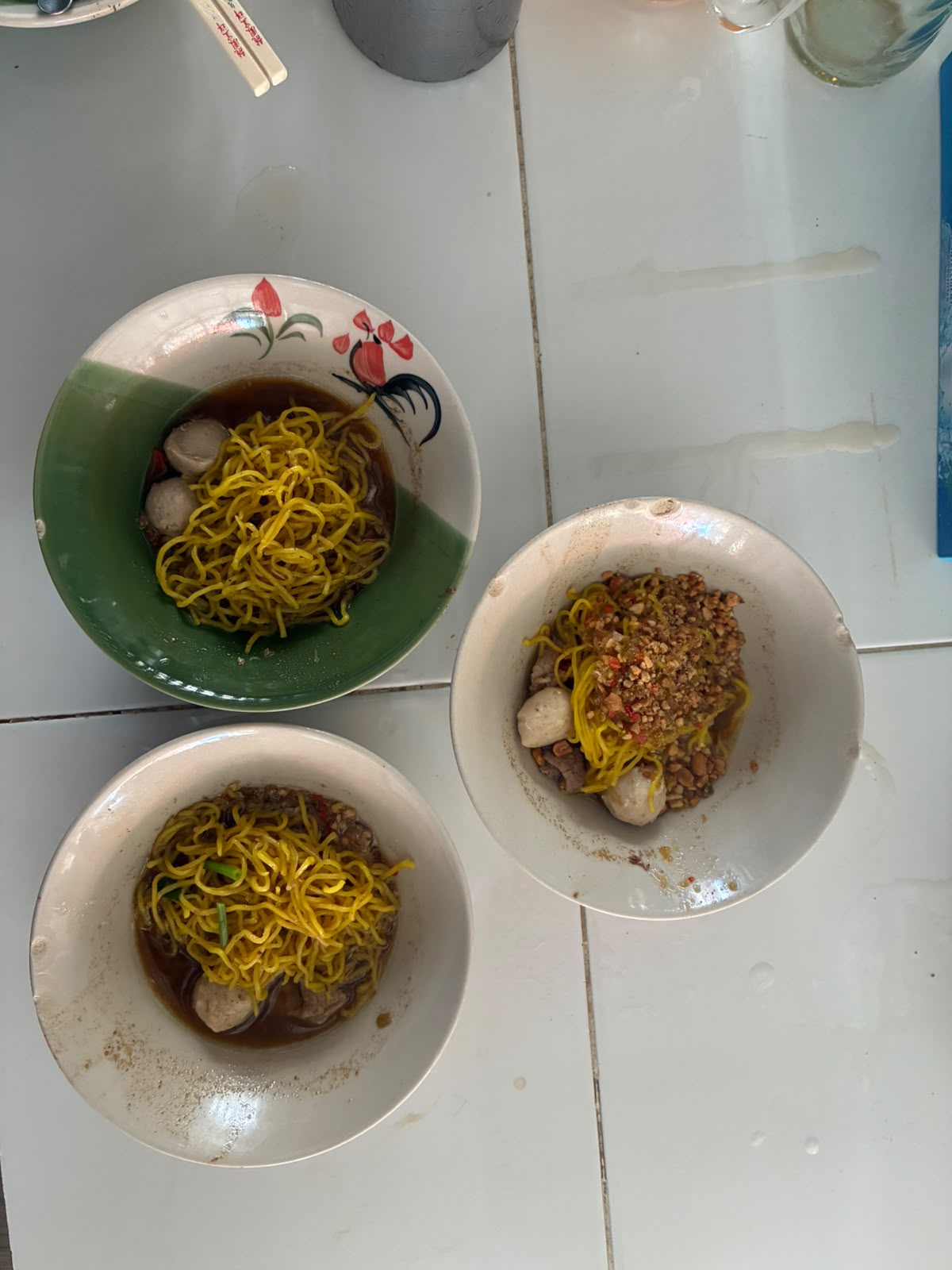
The boat noodle does not exist to impress anyone. This is fundamental to understanding it — and to understanding why the bowl that arrives at Pa Lek on a busy street in Ayutthaya is so quietly devastating.
From the 12th century onwards, when Ayutthaya was the capital of the Siamese kingdom and its waterways were its commercial arteries, vendors sold noodles from canoes moving along the canals. Small bowls, passed across the gunwale to customers eating on the bank. The bowl was small because a large bowl was impractical on a moving boat. The price was low because the customers were people going somewhere, pausing briefly. The dish was a snack. It was never designed to make a point.
This is not preamble. It is the architecture of the surprise.
The queue at Pa Lek runs long and runs local. The system is precise in the way that only establishments operating at very high volume can afford to be: collect a laminated number card from a member of staff who has performed this action approximately fifty thousand seven hundred and eighty-four times before you arrived, wait, or walk briefly, return when called. The tables turn quickly. At the centre of the operation stands a lady chef on a small stool — elevated enough to see the whole room and direct it — overseeing a team at stations covering broth choices (pork or beef), noodle choices (thin rice noodles, glass noodles, wide rice noodles, egg noodles, vermicelli, and a dry version in which the broth becomes, in effect, a sauce), and a mise en place of pre-prepared seasonings in claypots that represents the kitchen's real intellectual labour, done before service rather than during it. A few tablespoons of seasoning into the bowl. Noodles blanched to order. A small, careful arrangement of meats. Broth poured over. The bowl arrives in under two minutes.
It costs twenty baht.
I will tell you what happened.
The bowl, when it arrives, is small — an amuse-bouche by European convention, a cappuccino by Italian reckoning, or, for American readers, a free sample at the deli counter. I use that last comparison with some deliberateness. What arrives does not look like much.
Less than one spoon in, I was doing the thing people do when something very good is happening to them in a public place and they are trying not to let the room know about it. The specific analogy that came to mind is not one typically deployed in food writing, but it is the accurate one: I was suppressing the sounds a person makes when receiving unexpected and considerable attention from beneath the tablecloth in a crowded restaurant. The restaurant was crowded: I was not successful.
Then the question arrived — the one that follows the first involuntary response and precedes any rational assessment: how. How does a broth this deep — tasting of star anise, cinnamon, coriander, what I took to be clove and nutmeg, with something at the back of the palate I could not immediately place (dried apricot, perhaps; something with a quiet, bitter citrus note working underneath) — come out of a kitchen operating at this speed, at this price, with this consistency?
The answer is, in part, blood. The traditional technique for this style of broth is called nam tok — "waterfall" — in which fresh blood is added to the stock at the end of cooking, thickening and enriching it in a way that changes the texture at the level of the spoon. It does not taste of blood in any sense a wary diner would recognise. It tastes like a bone broth that has been going since the previous Tuesday, deepened at every stage by something the cook has chosen not to explain. The broth has depth at multiple registers: something sweet, something dark and long, something that arrives late and low and persistent in the way that slow-cooked things do, and does not leave.
The different noodle varieties are not interchangeable. The thin rice noodle gives the broth a clean, precise grip. The glass noodle absorbs differently — it delivers the flavour in a longer, slower wave, the taste building rather than arriving. The thick wide noodle is a different argument entirely: it holds the broth against it rather than carrying it through. Try them in sequence. This will require ordering four bowls. The total expenditure will be eighty baht.
A note on Michelin, and then we are done with them.
The Guide has acknowledged Pa Lek with a Bib Gourmand — the designation awarded to establishments offering exceptional quality at accessible prices. This is, technically, not wrong. A bowl of broth of this quality at twenty baht is, by definition, exceptional value. The Bib Gourmand is also a statement about the limits of what an institution is prepared to conclude from the evidence in front of it.
What the broth at Pa Lek is doing is what the great kitchens in Lyon and Tokyo and Paris are also attempting: producing a stock of genuine depth and complexity, built across hours, that tastes as though it could not have been made any faster. It is doing it more convincingly than several of them charge three hundred euros to attempt. Michelin found this, considered it, and awarded the consolation accolade. Well, of course they did.
The temple complexes directly across the road have the quality of silence that justifies the trip to Ayutthaya independently of the meal. The journey from Bangkok takes seventy minutes by taxi. There is no version of this calculation that does not make immediate sense.