The Chao Phraya has been watching kitchens come and go from this building for the better part of sixty years. From the river, none of it matters much. The water is wide and brown and moving, and the view from the window of Le Normandie is the same view it has always been: magnificent, indifferent, belonging to no one.
The room, on the other hand, belongs to Humbert & Poyet now. It is beautiful in the way that a Premier Classe cabin on an Air France long-haul is beautiful — carefully considered, precisely finished, warm in the way that things designed to be warm invariably are. You would not mistake it for a design failure. You would not mistake it for Bangkok, either, which is a different kind of failure. The previous room, ornate and idiosyncratic and irreplaceable, was a specific thing in a specific place. This one is very good anywhere. That distinction matters when you have asked your guests to come to the Chao Phraya to sit in it.
On a Sunday lunch in June, the room held three tables. A Swedish couple occupied one corner — invited back, it was quietly understood, because something had gone wrong on a previous visit. An Asian couple occupied a second, accompanied by their own photographer, who moved around the table with the focused attention of someone for whom the meal was primarily compositional. The third table was mine. The room was not struggling in the way that rooms struggle. It was empty in the way that rooms are empty when the proposition has not yet found its audience.
This is not the cooking's fault.
The food that arrives from this kitchen is extraordinary. I want to say this at the outset and sustain it throughout, because the argument that follows is not an argument about the plate. It is an argument about the relationship between the plate and where it has been placed.
Three amuses arrive first: bright, fresh, precise, and genuinely feminine in the sense that the chef herself uses the word — which is not marketing language but a description of a sensibility. Light acid. Restrained sweetness. Nothing that announces itself before it is ready. They are the finest amuse-bouche sequence served in Bangkok. I have no doubt of this.
A carrot starter follows — vegetarian, architecturally confident, of such structural conviction that it makes most meat starters in this city feel tentative. It is crunchy and sharp and savoury in a sequence that arrives in waves rather than simultaneously. It is the sort of dish that makes you revise your understanding of what a vegetable can be asked to do.
Then the Berlingots.
The Berlingots are the signature — pyramid-shaped pastas, named for the hard French caramel candy of the same form, stuffed here with local brie, chamomile, saffron, and slightly sour tomatoes. The presentation is exact. The flavour is deep and specific and stops the table. They are also 1,800 baht per portion — approximately €47, before the 10% service charge and applicable government tax that the Mandarin Oriental applies with impressive consistency to everything on the menu, including the applicable government tax. They are worth it. The question is not whether they are worth it. The question is what it means to price them here, like this, in this room.
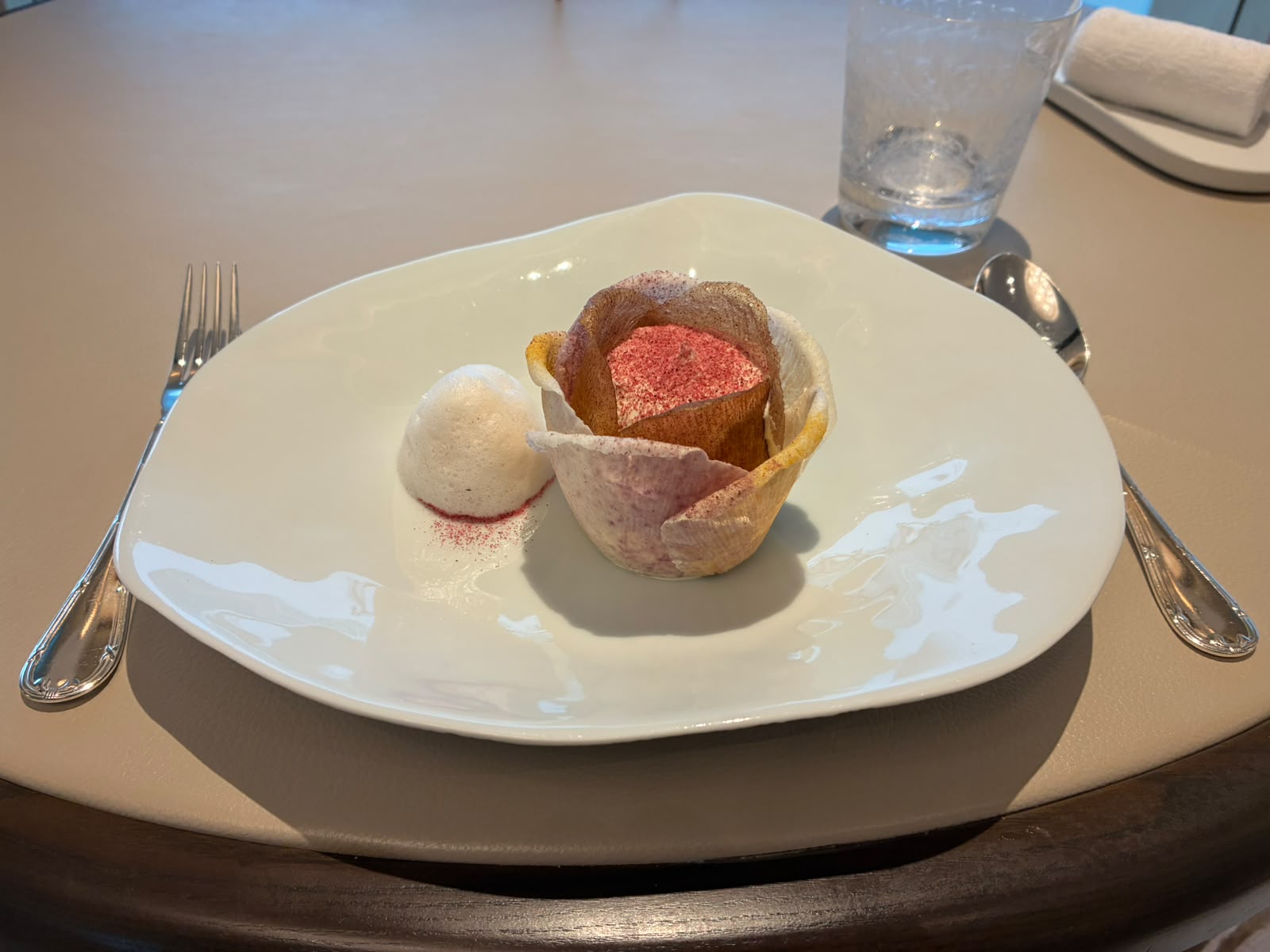
The cheese that arrives completes a picture that has been forming since the first amuse. This kitchen has arrived from Valence, France, and has not stopped to consider the geography of its new address. The Berlingots deliver a lactic intensity that, across an afternoon, accumulates with more aromatic persistence than a 128-day dry-aged T-bone. The Brie de Meaux — served with vanilla and milk jam as one preparation and as a separate, technically remarkable foam covering an ice cream of genuine delicacy as another — carries the full weight of its provenance.
It is worth noting that Brie de Meaux comes from Meaux: a town in Seine-et-Marne that sits measurably closer to Disneyland Paris than to the centre of Paris itself. Perhaps this is fitting. The cheese is excellent — the AOC designation ensures its pedigree, and the preparation is the most intelligent evolution of the cheese course I have encountered since Thomas Keller was conducting his laboratory-serious explorations at The French Laundry in the late 1990s. The foam and the ice cream are a genuine contribution to what a cheese course is permitted to be. It is also a Savoyard-adjacent dairy programme of considerable lactic intensity, offered in a city whose principal dairy reference point is sweetened condensed milk. The mismatch is not catastrophic. It is simply notable. And notable, in a room this quiet, becomes something you sit with.
The dessert resolves everything, briefly. A lotus millefeuille arrives looking like a reconstructed flower — vanilla and jasmine cream layered with Thai ginger flower and rose petal tuiles — assembled with the compositional deliberateness of something shown at a runway presentation. It plays with texture across registers in the manner that Peter Gilmore's Snow Egg played with texture at Quay in Sydney: the contrast between lightness and weight, between what you see before you eat and what you taste as you do. The lotus millefeuille is more beautiful than it has any right to be, and more delicious than even its appearance suggests. It is a masterpiece that deserves a room with more people in it.
A word on price, and the history it rewrites.
Under Alain Roux, who arrived in December 2021 inheriting two Michelin stars from the Dunand Sauthier era, Le Normandie's gastronomic tasting menu was priced at 7,500 baht. The restaurant retained both stars through the 2022 and 2023 Michelin Guide Thailand editions, before losing one in the 2024 Guide. A guest residency by Alex Dilling of Hotel Café Royal followed from September 2024 to January 2025, during which the restaurant held one star, before Anne-Sophie Pic took over in September 2025. Under Pic, the seven-course Voyage menu is 9,000 baht — a 20% increase on the pre-residency price. Add the prestige wine pairing at 11,000 baht and a dinner for one moves above 20,000 baht before tax, or approximately €526 at current rates. For Bangkok. On a Sunday. When the room contains three tables.
This is not a number that explains itself by the cooking alone.
Le Normandie held two Michelin stars under Arnaud Dunand Sauthier, the Savoie-born chef who spent nine years in this room before departing in 2021 to open Maison Dunand — his own atelier in a house remade as a contemporary Alpine chalet on the other side of the city. Dunand Sauthier performed a considerable trick: he made Alpine French cuisine feel, somehow, at home on the Chao Phraya. He understood something about Bangkok that is easy to describe and difficult to execute: that the city has the appetite for culinary complexity but not necessarily for the specific European cultural references that complexity sometimes carries with it. He translated. The cooking bore his geography; it served the city's palate. The restaurant has been working to find its equivalent understanding since he left.
Anne-Sophie Pic is the most Michelin-starred female chef in the world. This is, in 2026, a fact rather than a promotional claim. Her flagship in Valence holds three stars. The restaurants she has opened in London, Lausanne, Dubai, and Hong Kong carry their own recognition. The Bangkok collaboration now holds two Michelin stars, which are correctly awarded for the cooking and do not resolve the question of what this restaurant is doing in Bangkok, for whom, and at what price.
The cooking is not the problem. The problem is a room that is beautiful and legible and could be installed in Paris or Singapore or Hong Kong without anyone noticing the difference. The problem is a cheese programme of considerable Savoyard intensity offered to a city that did not request it. The problem is a Sunday afternoon in June when the most decorated female chef in the world has three tables and a couple with their own photographer.
None of these are problems with the plate. The plate is exceptional. The lotus millefeuille alone is worth the taxi.
The Chao Phraya is still out there. It does not have an opinion. This is noted.