There is a particular Amsterdam fantasy, one the city has been quietly indulging for decades, in which a restaurant can borrow its atmosphere from its clientele. The logic runs as follows: if you seat a former television jury member at one table and a well-known showbusiness lawyer at another, the room acquires a certain wattage by association, and the kitchen is somehow absolved of the obligation to match it. You find this fantasy most completely realised on the Utrechtsestraat, where De Juwelier has been operating since 2021 with the ambition of being several things simultaneously: a luxury brasserie, a neighbourhood institution, and a somewhere worth being seen.
The pedigree is not in question. De Juwelier is the brasserie project of Richard van Oostenbrugge and Thomas Groot, the two-Michelin-starred team behind Restaurant 212 on the Amstel, who also operate Bistrot de la Mer and, opening shortly on the same street, Kama, Amsterdam's first handroll bar. They are, by any measure, one of the more ambitious restaurant groups currently operating in the city. De Juwelier is their deliberately accessible proposition: a classical brasserie where an early bird menu offers three courses for forty-three euros. That is not a great deal of money for a kitchen of this provenance, and the expectation it creates is not unreasonable.
A colleague and I arrived to a genuinely warm reception. The greeting was immediate, the staff attentive without being performative, and there was a card waiting on the plate — a small, considered gesture — offering a selection of snacks. We chose two at seven euros apiece: a cheese soufflé and pommes duchesse. The bread that followed was good, the butter better than it needed to be. For a brief moment, the calibration seemed right.
The soufflé arrived the size of an afterthought. It had flavour — the old crumbly cheese came through clearly — but the portion was so absurdly modest that the flavour had nowhere to go. The pommes duchesse were, at best, the kind of thing you might find pre-packaged in the chilled section of a supermarket: competent, inoffensive, and entirely without ambition. The plates on which they arrived were charming. This is not a review of the crockery.
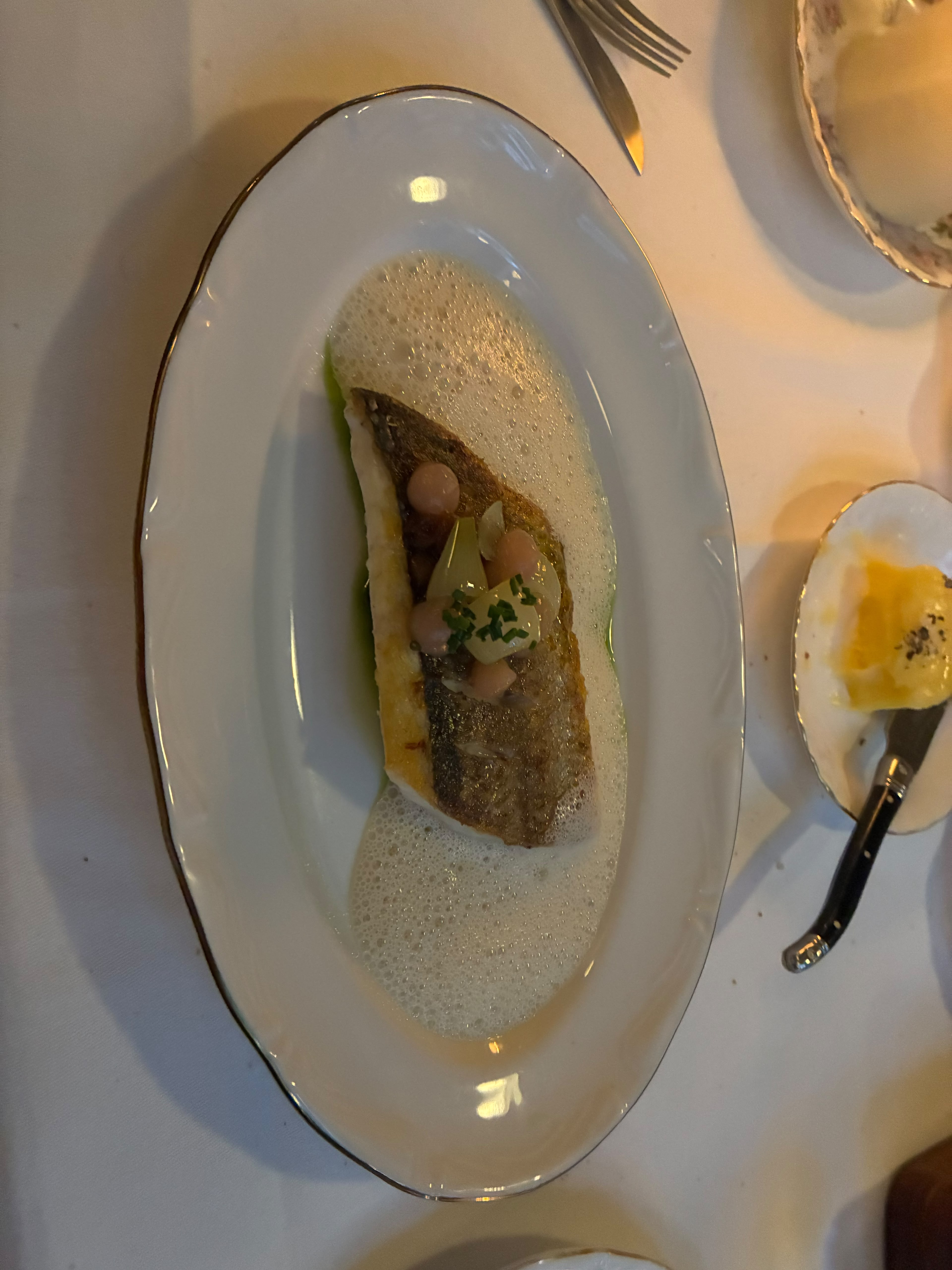
We were on the early bird menu — no choices, no deliberation, the kitchen decides and the waitress confirms. And confirm she did, on arrival, clearly: tomato salad to start, skate wing to follow, baba au rhum to close. It is about as contractual as a restaurant gets short of a signed document. What subsequently appeared was rather different. The skate wing, listed at twenty-eight euros and described as served on the bone with a shallot hachée and a sauce of mace, had been replaced by the kitchen with sea bass at thirty-two euros. The baba au rhum — one of the great desserts of the French classical canon — had been replaced with strawberries. No word from the kitchen. No word from the floor. A confirmed menu, verbally agreed at the table, changed without the table being informed. At a Michelin-starred restaurant, that is not an oversight. It is a breach of the most basic agreement a restaurant makes with its guests.
The sea bass itself was very good. The white wine sauce had a precise, beautiful acidity — the kind of clean brightness that requires genuine technique — and the fish was handled with care. The strawberry dessert was bright and pleasant, the shiso vinaigrette doing its job with a light, refreshing hand. Neither dish was the point. The point was that neither dish was what we had been told we would eat.
At the table beside ours, a family had gathered to celebrate a son's thirtieth birthday. Champagne had been opened, wine was flowing, and the mood was exactly what a good brasserie should produce: warm, generous, unhurried. Then the food arrived — two of three dishes correctly placed, the third deposited in front of the mother, who had ordered fish and found herself presented with a steak knife. The plates, it emerged, had been sent to the wrong table entirely, apparently intended for a party upstairs. The wait for the correct dish, on a thirtieth birthday, with the champagne slowly going flat, was longer than it had any right to be. It is the kind of error that a well-run floor catches before it reaches the table. It is also the kind of error that, at this level, should not happen at all.
De Juwelier is not a failing restaurant. The room has warmth, the welcome is genuine, and when the kitchen commits it can produce something worth the journey. But a Michelin-starred brasserie run by one of Amsterdam's most talented duos cannot coast on pedigree alone. There is a generosity of spirit in the best brasseries — a sense that the kitchen is actively delighted you showed up — that you find at a Badcuyp or a Stern, and a quality of service that makes an evening feel genuinely special, the schwung that once distinguished Le Garage and that you now find at Bisous. De Juwelier, four years in, offers something polished but not quite alive. The group is building an empire on the Utrechtsestraat. The flagship needs to decide whether it intends to lead it.